Guying
Overview
Mechaphlowers provides simple guying calculations necessary for field work involving guy cables. The guying module calculates the forces in guy cables and the associated vertical, horizontal, and longitudinal loads.
Guying is performed by using the loads at the selected support (the VHL - Vertical, Horizontal, Longitudinal loads) which are themselves calculated via the balance physics engine.
Key Features
- Guy cable tension calculation: Determines the tension in the guy cable based on geometry and applied loads
- Load analysis: Calculates the vertical, horizontal, and longitudinal components of forces
- Support with or without pulley: Allows modeling of two different configurations
- Side management: Supports guying on the left or right side of the support
Warning
The naming of left and right for guying may be confusing. Note that for a selected support, if you guy to the left of the support, you need to retrieve the VHL to the right of the support, as seen in the code.
Assumption
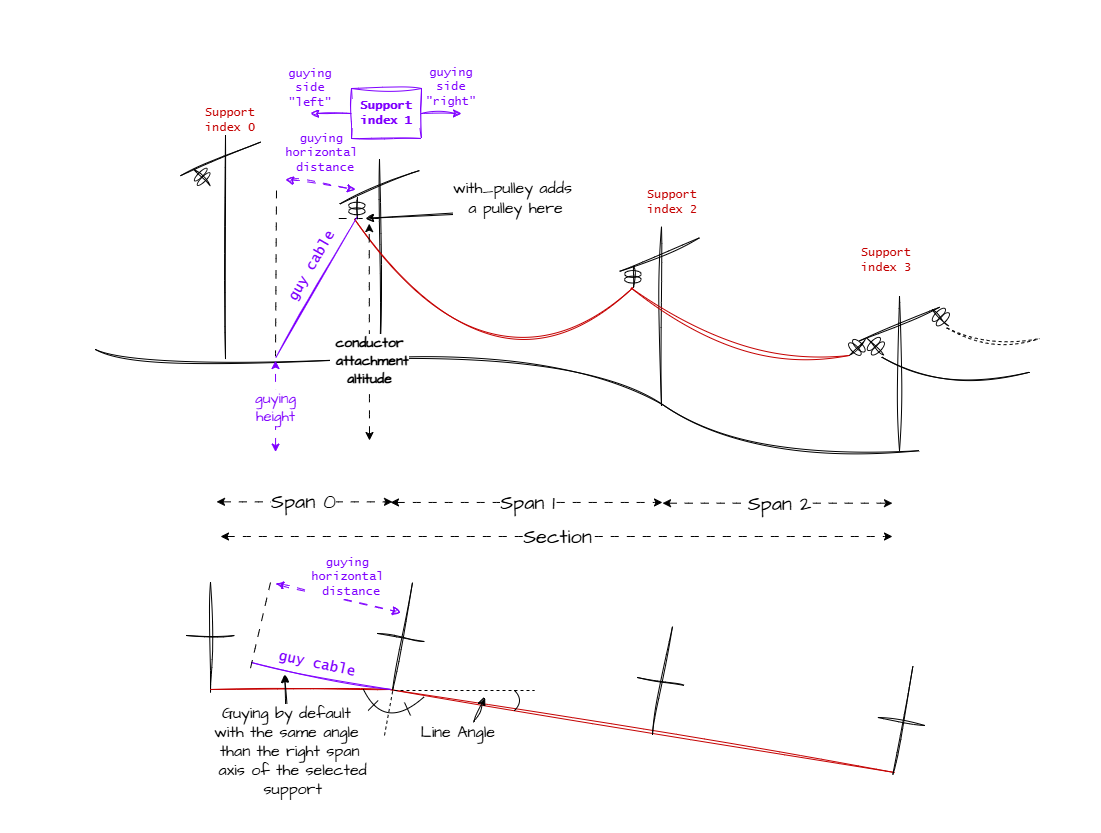
When there is an angle in the line, the guy cable is placed along the span axis. (see chart)
Geometric Configuration
It is possible to use a pulley on suspension supports (neither the first nor the last support). The configuration without a pulley corresponds to a direct guy cable, while the configuration with a pulley uses the span tension to calculate the tension in the guy cable.
Warning
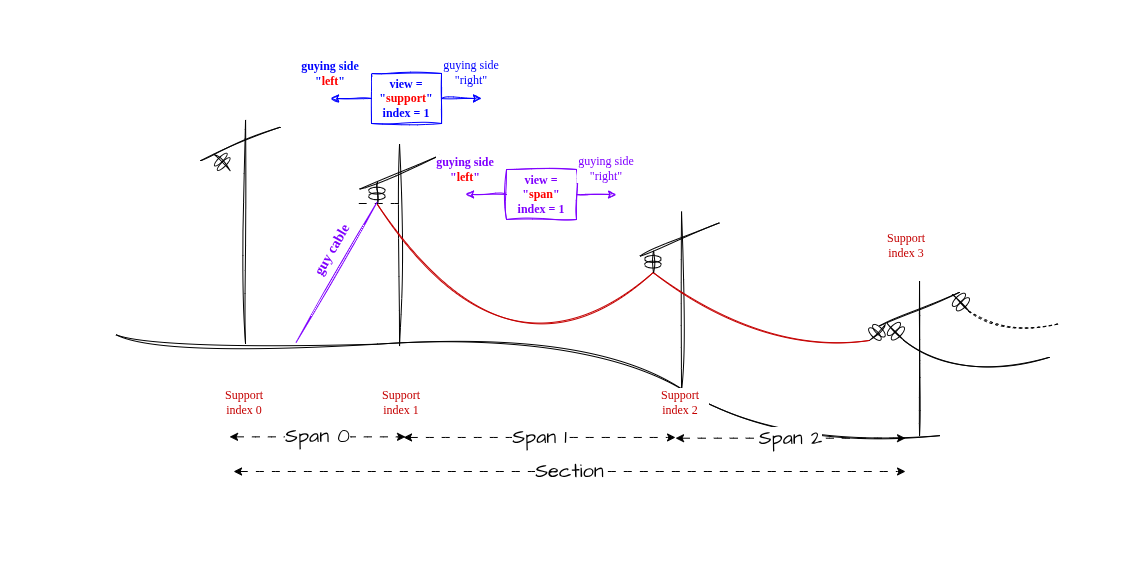
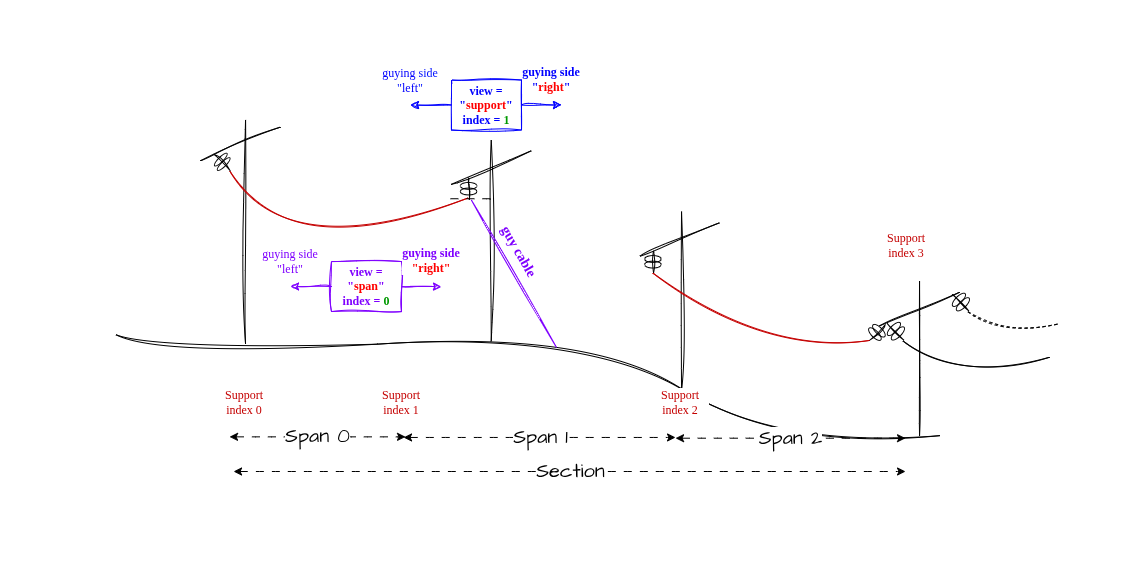
In the charts below you can see the impact of the view parameter.
Be careful to the point of view you choose when setting guying parameters.
Indeed support index and span index is not the same if guying side is right
Usage Example
Here is a complete example showing how to calculate guying efforts:
1 2 3 4 5 6 7 8 9 10 11 12 13 14 15 16 17 18 19 20 21 22 23 24 25 26 27 28 29 30 31 32 33 34 35 36 37 38 39 40 41 42 43 44 45 46 47 48 49 50 51 52 53 54 55 56 57 58 59 60 61 62 63 64 65 66 67 68 69 70 71 72 73 74 75 76 77 78 79 80 81 82 83 84 85 86 87 88 89 90 91 92 | |