Sag-tension calculations for dead-end span
External loads
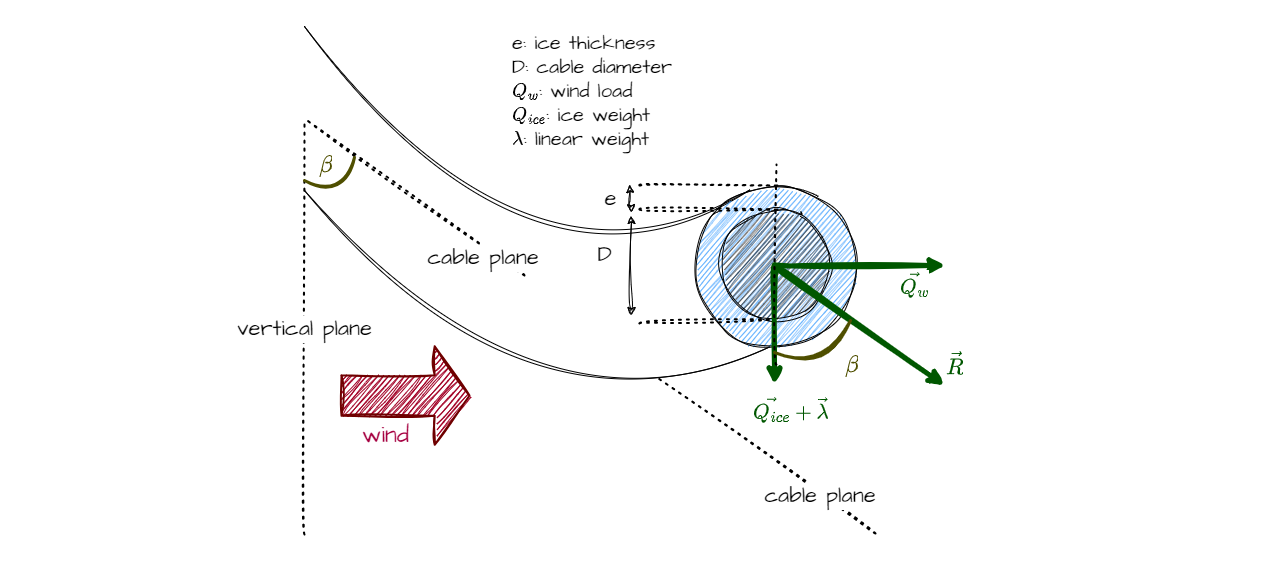
A cable is subject to three main types of external loads:
- The wind load, denoted as \(Q_w\):
where \(D\) is the cable diameter, \(e\) the ice thickness and \(P_w\) the wind pressure.
- The ice weight per unit length, denoted as \(Q_{ice}\):
where \(D\) is the cable diameter, \(e\) the ice thickness and \(\rho_{ice}\) the ice density, typically ranging from \(2000\) to \(9500\ \mathrm{N/m^3}\) (default value is \(6000\ \mathrm{N/m^3}\)).
- The cable linear weight, denoted as \(\lambda\), that reflects the intrinsic weight of the cable per unit length.
Thus, the total resultant force \(R\), acting on the cable, is calculated as:
Load coefficient
The load coefficient \(m\) quantifies the impact of the external loads on the horizontal tension. It is defined as:
The connection between the sagging parameter \(p\), the cable linear weight \(\lambda\), and the horizontal tension \(T_h\), already defined in the cable modeling section, is:
Load angle
The load angle \(\beta\) indicates the direction of the resultant \(R\):
Sag-tension calculation algorithm
We want to determine the new horizontal tension when additional loads and/or thermal changes are applied on the cable. The steps are as follows:
-
Update the cable plane by calculating the new angle (\(\beta\)).
-
Adjust sagging parameters:
- Compute \(a'\) and \(b'\) (adjusted span length and height difference)
- Update the cable's effective length, \(L'\)
-
Calculate the strain from two methods. The first method is from the reference length:
And the second method from the strain-stress relationship:
- Determine the remaining error: since strain depends on \(T_h\), determine the error function for iterative solutions:
Example: resolution using Newton-Raphson method
To solve \(f(T_h) = 0\) for horizontal tension:
- Approximate the derivative:
where \(\zeta = 10\ \mathrm{N}\) is the step size.
- Iterative solution formula:
- Converge to the result: start with an initial guess \({T_h}_0 = T_{h0}\) and iterate until \(f(T_h)\) approaches zero.